Plumbaginaceae is a family of flowering plants, with a cosmopolitan distribution. The family is sometimes referred to as the leadwort family or the plumbago family.


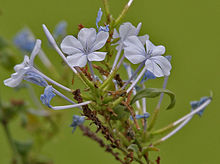

Most species in this family are perennialherbaceous plants, but a few grow as lianas or shrubs. The plants have perfect flowers and are pollinated by insects. They are found in many different climatic regions, from arctic to tropical conditions, but are particularly associated with salt-rich steppes, marshes, and sea coasts.
The family has been recognized by most taxonomists. The APG II system (2003; unchanged from the APG system of 1998), recognizes this family and assigns it to the order Caryophyllales in the clade core eudicots. It includes ca 30 genera and about 725 species.[2]
The 1981 Cronquist system placed the family in a separate order Plumbaginales, which included no other families. The Dahlgren system had segregated some of these plants as family Limoniaceae.
Genera
- Acantholimon
- Aegialitis
- Afrolimon
- Armeria, the thrifts or seapinks
- Bamiana
- Bukiniczia
- Cephalorhizum
- Ceratostigma, the leadworts
- Chaetolimon
- Dictyolimon
- Dyerophytum
- Eremolimon
- Ghaznianthus
- Goniolimon
- Ikonnikovia
- Limoniastrum
- Limoniopsis
- Limonium (syn. Statice), the sealavenders
- Muellerolimon
- Neogontscharovia
- Plumbagella
- Plumbago, the leadworts or plumbagos
- Popoviolimon
- Psylliostachys
- Saharanthus
- Vassilczenkoa
Cultivation and uses
Chalk glands are found in this family. The family includes a number of popular gardenspecies, which are grown for their attractive flowers.
| This article uses material from the Wikipedia article Metasyntactic variable, which is released under the Creative Commons Attribution-ShareAlike 3.0 Unported License. |