Meliaceae, the mahogany family, is a flowering plant family of mostly trees and shrubs (and a few herbaceous plants, mangroves) in the order Sapindales.


They are characterised by alternate, usually pinnate leaves without stipules, and by syncarpous,[2] apparently bisexual (but actually mostly cryptically unisexual) flowersborne in panicles, cymes, spikes, or clusters. Most species are evergreen, but some are deciduous, either in the dry season or in winter.
The family includes about 53 genera and about 600 known species,[3] with a pantropical distribution; one genus (Toona) extends north into temperate China and south into southeast Australia, another (Synoum) into southeast Australia, and another (Melia) nearly as far north.
The fossil record of the family extends back into the Late Cretaceous.[4]
Uses
Various species are used for vegetable oil, soap-making, insecticides, and highly prized wood (mahogany).
Some economically important genera and species belong to this family:
- Neem tree Azadirachta indica (India)
- Carapa: includes the "crabwood trees" e.g. Carapa procera (South America and Africa)
- Cedrela odorata Central and South America; timber also known as Spanish-cedar
- Entandrophragma: includes sapele and "utile" or "sipo" (E. utile) of tropical Africa
- Guarea, the genus of Bossé or "pink mahogany" includes: G. thompsonii and G. cedrata (Africa)
- Khaya includes: Ivory Coast Mahogany and Senegal Mahogany (tropical Africa)
- Chinaberry or white cedar, Melia azedarach(Indomalaya and Australasia)
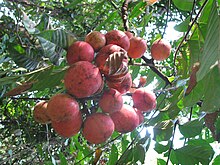
- Santol (Sandoricum koetjape), grown for their edible fruit in Southeast Asia and South Asia
- Lanzones (Lansium parasiticum), grown for their edible fruit in Southeast Asia
- Swietenia is the classic "mahogany" genus from the tropical Americas
- Toona: the genus of "toon tree" species (tropical Asia, Malesia, and Australia), especially Toona ciliata
| This article uses material from the Wikipedia article Metasyntactic variable, which is released under the Creative Commons Attribution-ShareAlike 3.0 Unported License. |