The Euphorbiaceae, the spurge family, are a large family of flowering plants. In common English, they are sometimes called euphorbias,[2] which is also the name of a genus in the family. Most spurges such as Euphorbia paralias are herbs, but some, especially in the tropics, are shrubs or trees, such as Hevea brasiliensis. Some, such as Euphorbia canariensis,[3]:206 are succulent and resemble cacti because of convergent evolution.[4] This family occurs mainly in the tropics, with the majority of the species in the Indo-Malayan region and tropical America a strong second. A large variety occurs in tropical Africa, but they are not as abundant or varied as in the two other tropical regions. However, the Euphorbiaceae also have many species in nontropical areas such as the Mediterranean Basin, the Middle East, South Africa, and the Southern United States.


Description

The leaves are alternate, seldom opposite, with stipules. They are mainly simple, but where compound, are always palmate, never pinnate. Stipules may be reduced to hairs, glands, or spines, or in succulent species are sometimes absent.
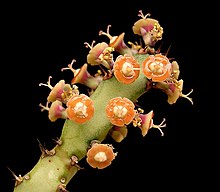
The plants can be monoecious or dioecious. The radially symmetrical flowers are unisexual, with the male and female flowers usually on the same plant. As can be expected from such a large family, a wide variety exists in the structure of the flowers. The stamens(the male organs) number from one to 10 (or even more). The female flowers are hypogynous, that is, with superior ovaries.
The genera in tribe Euphorbieae, subtribe Euphorbiinae (Euphorbia and close relatives) show a highly specialized form of pseudanthium ("false flower" made up of several true flowers) called a cyathium. This is usually a small, cup-like involucreconsisting of fused-together bracts and peripheral nectary glands, surrounding a ring of male flowers, each a single stamen. In the middle of the cyathium stands a female flower, a single pistil with branched stigmas. This whole arrangement resembles a single flower.
The fruit is usually a schizocarp, but sometimes a drupe. A typical schizocarp is the regma, a capsular fruit with three or more cells, each of which splits open explosively at maturity, scattering the small seeds.
The family contains a large variety of phytotoxins (toxic substances produced by plants), including diterpene esters, alkaloids, and cyanogenic glycosides (e.g. root tubers of cassava). The seeds of the castor oil plant Ricinus communis contain the highly toxiccarbohydrate-binding protein ricin.[5]
A milky latex is a characteristic of the subfamilies Euphorbioideae and Crotonoideae, and the latex of the rubber tree Hevea brasiliensis is the primary source of natural rubber. The latex is poisonous in the Euphorbioideae, but innocuous in the Crotonoideae.[citation needed] White mangrove, also known as blind-your-eye mangrove latex (Excoecaria agallocha), causes blistering on contact and temporary blindness if it contacts the eyes, hence its name. Other common names are milky mangrove, buta buta(Malay), and gewa (Bangladesh). The latex of spurge was used as a laxative.
Recent molecular studies have shown that the enigmatic family Rafflesiaceae, which was only recently recognized to belong to order Malpighiales, is derived from within the Euphorbiaceae.[6]
Taxonomy
The family Euphorbiaceae is the fifth-largest flowering plant family[7] and has about 7,500 species[8] organised into 300 genera,[7] 37 tribes, and three subfamilies.[citation needed]
Uses and toxicity
Some species of Euphorbiaceae have economic significance, such as cassava(Manihot esculenta), castor oil plant (Ricinus communis), Barbados nut (Jatropha curcas), and the Para rubber tree (Hevea brasiliensis). Many are grown as ornamental plants, such as poinsettia (Euphorbia pulcherrima) or garden croton (Codiaeum variegatum). Leafy spurge (Euphorbia esula) and Chinese tallow(Triadica sebifera) are invasive weeds in North America.[9]
The most dangerous Euphorbiaceae member is the castor oil plant (Ricinus communis L.) because of their ricin content in the seeds.
Although some species of the Euphorbiaceae have been used in traditional medicine,[10] as of 2019, there is no rigorous clinical evidencethat euphorbia extracts are effective for treating any disease. Numerous Euphorbiaceae species are listed on the poisonous plant database of the US Food and Drug Administration mainly because of the toxic sap.[11]
Phytochemistry
Phytochemicals found in Euphorbiaceae species include diterpenoids, terpenoids, flavonoids, alkaloids, tannins, neriifolins, also found in oleander, cycloartenol, lectin, and taraxerol, among others.[10][12]
Vulnerability and presumed extinction
Some species, despite their medicinal benefits, are facing the risk of becoming extinct.[13][14] These include the Euphorbiaspecies E. appariciana, E. attastoma, E. crossadenia,[15] and E. gymnoclada.
| This article uses material from the Wikipedia article Metasyntactic variable, which is released under the Creative Commons Attribution-ShareAlike 3.0 Unported License. |