Cunoniaceae is a family of 27 genera and about 310 species[3] of woody plants in the order Oxalidales, mostly found in the tropical and wet temperate regions of the Southern Hemisphere. The greatest diversity of genera are in Australia and Tasmania (15 genera), New Guinea (9 genera), and New Caledonia (7 genera). The family is also present in Central America, South America, the Caribbean, Malesia, the island of the South Pacific, Madagascar and surrounding islands. the family is absent from mainland Asia except from Peninsular Malaysia, and almost absent from mainland Africa apar vyt from two species from Southern Africa (Cunonia capensis, Platylophus trifoliatus). Several of the genera have remarkable disjunct ranges, found on more than one continent, e.g. Cunonia(Southern Africa & New Caledonia), Eucryphia(Australia & South America) Weinmannia sect. Weinmannia (America and the Mascarenes).
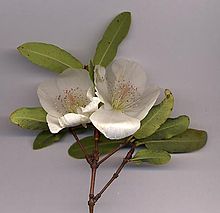

The family includes trees and shrubs; most are evergreen but a few are deciduous. The leaves are opposite or whorled (alternate in Davidsonia), and simple or compound (pinnate or palmate), with entire or toothed margin, and often with conspicuous stipules(interpetiolar or intrapetiolar). The flowershave four or five (rarely three or up to ten) sepals and petals. The fruit is usually a woody capsule or a follicle containing several small seeds.
The family has a rich fossil record in Australia[4] and fossil representatives are known in the Northern Hemisphere. Platydiscus peltatus was found in Upper Cretaceous rocks from Sweden and is likely a member of the Cunoniaceae.[5] An earlier possible fossil member is from the Cenomanian. Tropidogyne, found in Burmese amber, has flowers that strongly resemble the extant Ceratopetalum.[6]
| This article uses material from the Wikipedia article Metasyntactic variable, which is released under the Creative Commons Attribution-ShareAlike 3.0 Unported License. |